PPS Personnel
We deploy in teams to meet the criteria of our customers. With crews ranging from one to multiple mechanics our staff is trained in a tiered structure of technical complexity and are dispatched to jobs which fit their expertise. PPS mechanics possess mechanical skills with plumbing and gas experience. These individuals are organized and self-motivated to be high efficiency and thorough workers.
PPS Equipment & Tooling
All mechanics carry the standard toolkit which includes hand tools, gauges, and communication items. Specialty crews are outfitted with additional meter handling gear for large scale jobs as well as the necessary equipment for CNG bypass jobs. Vehicles include cargo vans, box vans, pick-up trucks and SUVs, all customized to fit meter exchange and/or emergency response purposes.
 PPS Methodology
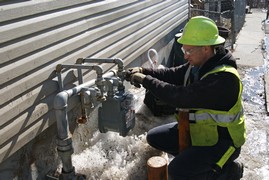
Each PPS mechanic is dispatched a work order which could be either a pre-scheduled appointment by our internal dispatchers or work off a list of cold-calls. Each mechanic organizes their work day in a sensible geographical route and upon arrival makes customer contact, and then gains access to the meter, verifies meter information, performs the necessary tasks, relights or red-tags as necessary, enters the exchange information into the portable tablet device including photographs, and leaves the site in at least as good condition as when arrived.
PPS Safety
PPS maintains a company-wide safety program, with many specific safety initiatives focused on the high risk areas of the work day. Field Managers complete Tailboard Talks discussing ways to be alert and mitigate typical and environment-specific hazards, and each mechanic is issued a standard kit including PPE, fire extinguisher, and traffic/vehicle protection. In addition, mechanics not working in multi-person teams on one site follow a safety contact communication chain with the field supervisors.
PPS Quality Control & Quality Assurance
SONY DSC
PPS maintains a multi-layer approach to Quality: 1) Personal Accountability of each mechanic, 2) Project-level Quality Control performed by supervisory personnel, and 3) Company-level Quality Assurance.
A key characteristic of each PPS employee is to be accountable for one’s own work and to hold the work to the highest personal standards. We accomplish this through maintaining a quality-conscious culture that operates as an extension of in-house utility forces. Each mechanic completes documentation (paper or digital) after each job; these documents provide a step-by-step walkthrough of the job and are signed off by the mechanic.
Supervisory personnel perform Quality Control (QC) activities for their teams that include random spot checks, process audits, documentation audits, and verbal knowledge-based assessments. A checklist is used to document the findings of the QC program and enables the supervisors to objectively assess and measure the ability of each mechanic.
Company-level QA performs knowledge-based assessments, manages training cycles, and reviews program procedures. QA also audits a sampling of job documentation and the QC checklists at the start of any new engagement.
PPS Emergency Response
We take a very structured yet flexible approach to Emergency Response Management (ERM). Our active services range from on-call odor responders to full-scale deployments due to natural disasters, major storms, or other abnormal events. Our Field Managers double as ERM supervisors coupling their knowledge of gas systems with the level headedness of situation controllers. We create a client and/or situation specific guidebook to outline the response including command and control, communications, staging, staffing and equipment, each facet designed to bring swift resolution to the situation and minimize risk to the customers.
 PPS Data Management
High Efficiency and Accuracy is directly tied to the effective use of technology in today’s fast paced work environment. PPS has found that utilizing custom software on the Android platform for use with Tablet handheld devices can deliver the results necessary to manage, track, schedule, and report field information in batch or real-time basis; this is critical step to success of any large-scale program. As an integral part of being fully turnkey, our team links to client systems and feeds information through our dispatcher to field teams concerning work orders, and our mechanic turns around all the necessary exchange information in a fully paperless system. The software reduces human error by utilizing data validation and eliminates double-data entry on the client’s side by sending the information back to the client’s systems.


 PPS Personnel
 PPS Equipment & Tooling